The Retail Technology Problem
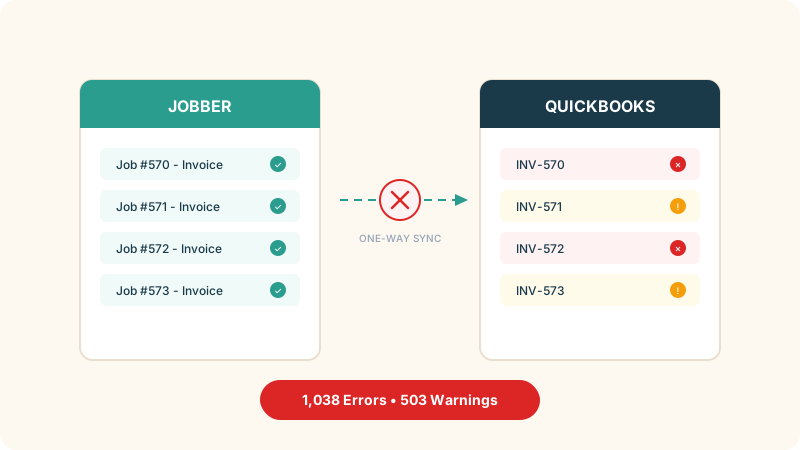
Calgary retail businesses are caught between two worlds. You need the in-store experience to work smoothly - point of sale, inventory, customer service. And you need the online side to keep up - ecommerce, order fulfillment, and customer data. Most retailers end up with separate systems for each, and spend hours every week reconciling inventory, sales, and customer records between them.
This is not just a technology problem. It is a profitability problem. When your online store shows an item in stock that your shop floor sold yesterday, you lose a customer. When your purchasing team cannot see real-time sales velocity across all channels, you either overstock or run out. And when your accountant needs to pull numbers from three different systems for month-end, you are paying for time that should be spent on analysis.
What Calgary Retailers Need
Unified Point of Sale and Inventory
Your POS system and your inventory management should be the same system - or at minimum, they should sync in real time. When a sale happens at your Kensington location, your 17th Avenue store should see the updated stock count immediately. This matters even more if you run seasonal pop-ups or markets - which many Calgary retailers do.
Ecommerce That Talks to Your Back Office
Whether you sell on Shopify, WooCommerce, or your own platform, your online orders need to flow into the same inventory and accounting system as your in-store sales. Manual order entry is a recipe for errors and delays.
Customer Data in One Place
Your best customers probably buy both in-store and online. If those purchase histories live in separate systems, you cannot identify your VIPs, run targeted promotions, or understand buying patterns. A single customer record across all channels is not a luxury - it is a basic requirement.
Multi-Location Management
Calgary retailers with more than one location need to manage inventory transfers, location-specific pricing or promotions, and per-location performance reporting. This gets complicated fast if your systems were not built for it.
Purchasing and Supplier Management
Retail margins are thin. You need to track supplier pricing, manage purchase orders efficiently, and understand your landed costs. The difference between a profitable quarter and a break-even quarter often comes down to purchasing decisions.
Software Options for Calgary Retailers
The retail software market splits roughly into POS-first platforms and ERP-first platforms. Which direction makes sense depends on where your biggest gaps are.
Lightspeed is a POS-first platform with strong inventory management built in. It handles multi-location retail well, includes built-in ecommerce, and has good reporting tools. For Calgary retailers whose primary challenge is in-store operations and inventory accuracy across locations, Lightspeed is a strong starting point. The limitation is that back-office functions like purchasing, accounting, and supplier management are lighter than what a full ERP offers.
Shopify POS makes sense for retailers whose online store is the primary channel and in-store sales are secondary. Shopify’s ecommerce platform is best in class, and the POS system ties directly into it. Inventory syncs across channels automatically. The trade-off is that Shopify’s back-office tools - accounting, purchasing, supplier management - are minimal. You will likely need additional software for those functions.
Odoo takes the opposite approach - it is an ERP with a POS module rather than a POS with ERP features. The POS runs on standard hardware and works offline, which matters for pop-up events or locations with unreliable internet. Because it includes accounting, purchasing, inventory, CRM, and ecommerce in one platform, it eliminates the reconciliation problem. Multi-location inventory transfers, loyalty programs, and barcode scanning are all built in. The trade-off is that the built-in ecommerce module is functional but less polished than Shopify, and complex promotions may need configuration work.
NetSuite is the enterprise option for multi-location retailers with complex operations. It handles high transaction volumes, sophisticated inventory allocation across locations, and detailed financial reporting. If you are running ten or more locations or doing significant wholesale alongside retail, NetSuite can handle that complexity. The price tag and implementation timeline reflect the enterprise positioning - this is a significant investment.
Where each option fits best:
- Single or multi-location retailers focused on in-store experience - Lightspeed
- Online-first retailers adding physical locations - Shopify POS
- Retailers wanting one integrated system for POS, inventory, accounting, and purchasing - Odoo
- Large multi-location or wholesale-retail hybrid operations - NetSuite
Areas to consider regardless of platform:
- Marketplace integrations (Amazon, Etsy) require third-party connectors on most platforms
- Complex promotions (buy 2 get 1 free across categories) should be tested during evaluation
- If you run seasonal pop-ups, test the offline POS capability specifically
Start Where It Hurts
If inventory accuracy is the biggest problem, start there. If it is the disconnect between online and in-store, focus on that integration. You do not need to replace everything at once - a phased approach reduces risk and lets your team adapt.
The best way to evaluate any retail platform is to run your actual daily workflows through it during a trial period. Process a day’s worth of real transactions, do a stock count, run your end-of-day reports. The platform that handles your reality with the least friction is the right one.