An ERP implementation in Alberta will cost somewhere between $5,000 and $250,000+. That is a wide range, and vendors love to hide behind that ambiguity. So here is a breakdown into something useful - actual price tiers, what pushes costs up or down, and what nobody tells you about the ongoing expenses after go-live.
The short version: most small-to-mid-sized Alberta businesses land in the $25K to $75K range for a properly scoped implementation with some customization. For standard operations - accounting, inventory, sales - with reasonably clean data, it is possible to come in under that. Heavy integrations with field service platforms or oil and gas industry software will push the number higher.
Three Pricing Tiers - Where Most Alberta Businesses Land
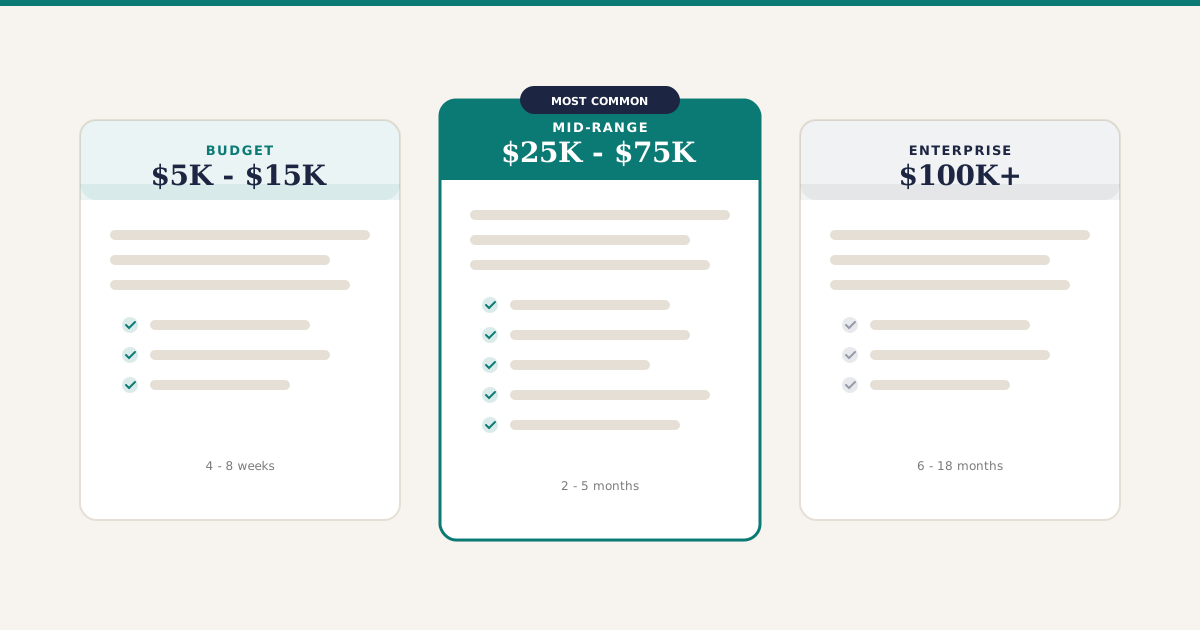
Budget Tier: $5,000 - $15,000
This is where open-source platforms like Odoo Community and ERPNext come in. Core modules - accounting, CRM, inventory - get configured to work with existing processes. At this level, the business is mostly adapting its workflows to fit the software rather than the other way around. Implementation typically takes 4 to 8 weeks. The trade-off is less customization, but for a 10-person company that needs to get off spreadsheets, this is a solid starting point. Working with a local consultant eliminates travel costs that eat into the budget.
Mid-Range: $25,000 - $75,000
This is where most growing Alberta businesses end up. The package includes a full implementation with customized workflows, data migration from the old system, integrations with two or three other platforms (ecommerce store, payment processor, shipping provider), and proper training for the team. Expect 2 to 5 months from kickoff to go-live. At this tier, platforms like Odoo Enterprise, Acumatica, and Sage Intacct are all common choices depending on the business profile. The consultants at this level should understand the specific industry and configure the system to match how the business actually operates - not just hand over a default setup.
Enterprise: $100,000+
SAP Business One, Oracle NetSuite, or Microsoft Dynamics 365 at full scale. Multi-location rollouts, complex manufacturing workflows, regulatory compliance modules, and deep integrations across dozens of systems. Implementation timelines stretch to 6 to 18 months. These projects typically involve teams of 5 to 10 consultants. For a $50M+ operation with hundreds of users, this tier makes sense. For everyone else, it is probably overkill.
What Drives the Cost Up
Customization is the biggest factor. Every custom report, workflow modification, or unique business rule adds development hours. A standard accounts-receivable process might take a day to configure. A custom approval chain with three tiers of authorization, automated notifications, and exception handling could take a week.
Data migration from legacy systems is consistently underestimated. Moving data from QuickBooks or Sage 50 is straightforward - a few days of work. Migrating 15 years of transaction history from a custom Access database with inconsistent formatting? That is a project in itself. Budget 10 to 20 percent of the total implementation cost for data migration alone.
Integrations add up quickly. Connecting an ERP to Shopify is well-documented and relatively fast. Building a custom API connection to a niche field service platform used in Alberta’s energy sector could run $5,000 to $15,000 per integration.
Training is where companies try to cut corners and pay for it later. Skipping proper training means the team uses workarounds instead of the system’s actual features, which defeats the purpose of the investment.
What Drives the Cost Down
Using standard workflows wherever possible. If the software’s default process for purchase orders works for the business, do not pay to customize it. Save the custom work for the processes that genuinely differentiate the company.
Clean, organized data before migration starts. Spending a week having the team clean up the customer list, remove duplicate vendors, and standardize the product catalog is free labour that directly reduces billable consulting hours.
A phased approach spreads cost over time and reduces risk. Go live with accounting and inventory first. Add manufacturing or project management in phase two, three months later. Each phase is smaller, more manageable, and less likely to derail.
Alberta-Specific Factors That Affect Pricing
Local vs. remote consultants. Hiring a Toronto or Vancouver firm typically adds $5,000 to $15,000 in travel expenses for on-site discovery sessions and training - flights, hotels, per diems. Working with a Calgary or Edmonton firm eliminates that line item entirely. For a mid-range implementation, that savings alone can cover the training budget.
The Calgary and Edmonton market has a growing pool of ERP consultants, but it is still smaller than Toronto or Vancouver. That said, local consultants tend to understand Alberta’s business landscape - the seasonal patterns, the resource sector dependencies, the regulatory environment - in ways that out-of-province firms simply do not.
Oil and gas complexity. Alberta’s energy companies often need specialized modules for joint venture accounting, production reporting, or field ticket management. These industry-specific requirements push implementations toward the higher end of each tier. A distribution company might spend $40K where an oilfield services company with similar headcount spends $65K.
The Hidden Costs Nobody Mentions Upfront
Annual licensing fees are the obvious one. Odoo Enterprise runs roughly $7 to $30 CAD per user per month depending on the apps. NetSuite starts around $1,500 per month base plus per-user fees. SAP Business One licenses can run $3,000+ per user as a one-time purchase or $100+ per user monthly on subscription. These are recurring costs that compound every year.
Ongoing support and maintenance typically runs 15 to 20 percent of the initial implementation cost annually. So a $50K implementation means budgeting $7,500 to $10,000 per year for support, bug fixes, and minor adjustments.
Upgrades happen whether you want them to or not. Cloud-based systems push updates automatically, which sometimes breaks customizations. On-premise systems need manual upgrades that can cost 20 to 40 percent of the original implementation.
Internal team time is the cost everyone forgets. Staff will spend hours in discovery meetings, testing, providing feedback, and learning the new system. For a mid-range implementation, estimate 100 to 200 hours of internal staff time spread across the team. That is real productivity being redirected.
When Does the Investment Pay Off?
Most Alberta businesses see positive ROI within 6 to 18 months. The payoff comes from reduced manual data entry (fewer errors, less staff time), better inventory management (less overstock, fewer stockouts), faster invoicing (improved cash flow), and actual visibility into the numbers instead of waiting for month-end reports.
A wholesale distributor that moves from spreadsheets to a properly implemented ERP can often recoup the investment in under a year just from inventory optimization and reduced order errors. A professional services firm might take closer to 18 months but gains long-term from better project costing and resource planning.
Questions to Ask Any ERP Consultant Before Signing
Before committing to a vendor or implementation partner, run through this checklist:
- What is the total cost of ownership over three and five years? Not just year one - include licensing, support, upgrades, and anticipated customization.
- Can you provide references from Alberta businesses of similar size and industry? Talk to those references without the vendor present.
- What is included in the quoted price and what is extra? Data migration, training, post-go-live support, and integrations are common items that get scoped out of initial quotes and added back as change orders.
- What does your typical implementation timeline look like, and what causes delays? An honest consultant will name client-side delays (slow data cleanup, decision bottlenecks) alongside their own.
- What happens if the project goes over budget or over time? Get the answer in writing. Fixed-price contracts protect the buyer. Time-and-materials contracts need a hard cap.
- How are annual price increases handled? Ask for the escalation clause in writing. A 5 percent annual increase on a $30K license turns into $38K by year five.
- What does the exit look like? If the platform or the relationship does not work out, how does data get exported? What format? At what cost?
- Who will actually do the work? The senior consultant in the sales meeting is not always the one configuring the system. Ask who the day-to-day project team will be.
Start by documenting must-have requirements versus nice-to-haves. Get three quotes from different vendors or consultants - at least one local to Alberta. Ask every vendor to break their quote into phases so the comparison is line items, not just totals. And set aside a 15 to 20 percent contingency buffer, because every implementation uncovers something unexpected.